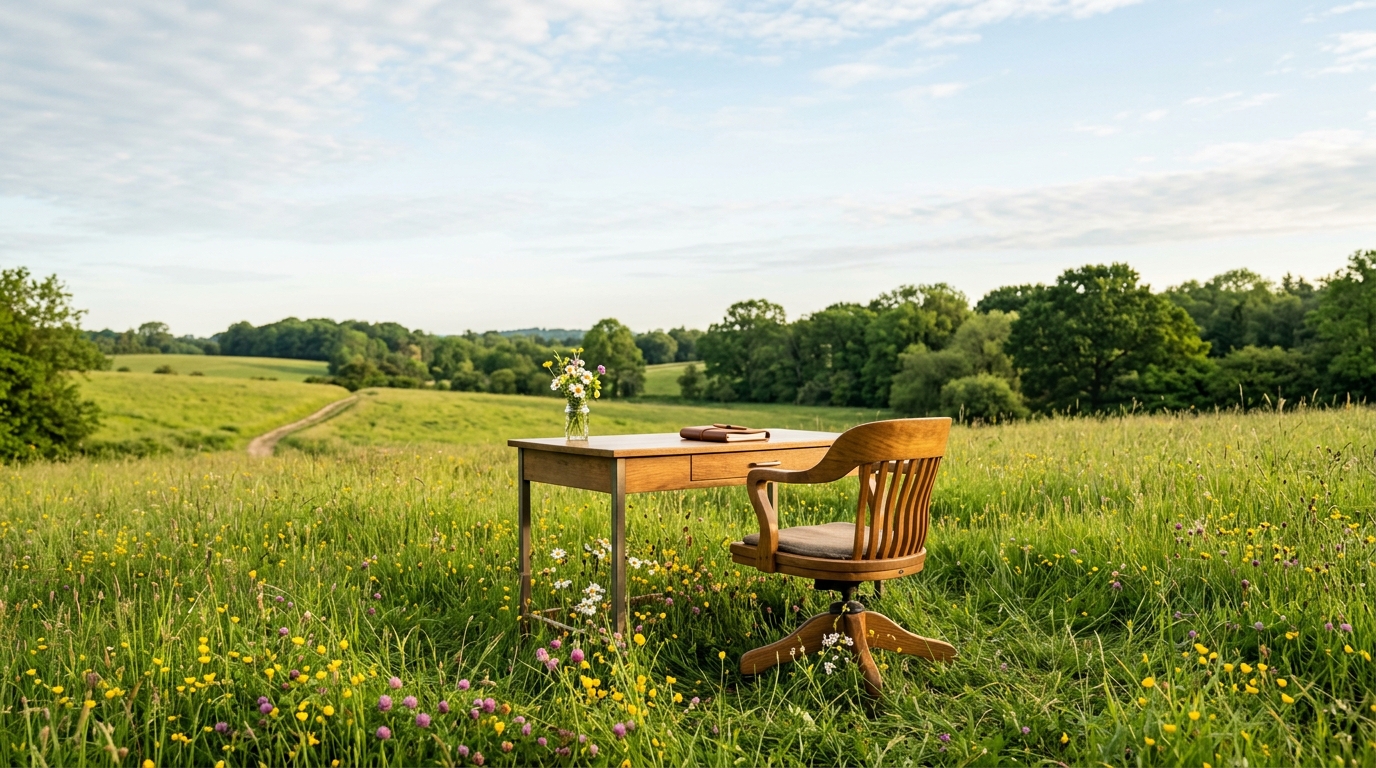
The world is changing. Most of us can feel it coming but we can't quite name it.
The desk job — the cubicle, the commute, the morning packed with meetings about other meetings — is starting to come apart. Artificial intelligence turns out to be remarkably good at the work a desk does. Drafting the memo, cleaning up the spreadsheet, summarizing the report, answering the routine email: these were the tasks that filled a million office days, and they're quietly becoming the things software finishes in seconds. Anthropic's own CEO, whose company builds some of the most capable AIs in the world, has warned that the technology could erase close to half of all entry-level white-collar jobs within a few years. Companies shed more than a million positions in 2025, and the desks emptied fastest. Even software development recruitment rates, out of college, have fallen from 96% just a few years ago to almost 0%.
I'm not going to wave that away. Losing a career you spent twenty years building is one of the most disheartening things that can happen to a person. I have been there and done that — in fact, it's why I started my business. A job isn't only a paycheck. It's a place to be every morning, a title that answers the question of who you are at the dinner party, a set of people who expect you. When that goes, the floor goes with it. Anyone who tells you otherwise is selling something.
The part the headlines keep missing? The people leaving those desks aren't vanishing. They're starting things. Thus our economy is shifting.
Americans are now filing close to half a million applications to start new businesses every month — roughly five million a year, well above the three and a half million that was normal before the pandemic. And more of those businesses than ever are being built by a solopreneur: the share of new companies launched by a single founder has climbed from under a quarter to better than a third in just a few years. This boom didn't begin with AI; it started earlier, in the upheaval of 2020. But AI is pouring fuel on it, because for the first time one determined person with the right tools can do the work that used to take a whole team. The barrier to building something of your own has never been lower.
Millions of people who spent their best hours under fluorescent light, moving information from one screen to another, are being pushed into the world. The accountant who always wanted to bake. The marketing manager who lights up when she's teaching. The analyst who's happiest with his hands in a garden bed. For a long time, the safe and sensible thing was to stay at the desk. The desk is no longer safe. And the thing waiting on the other side of it is older and better than the cubicle ever was: real work, done for real people, in a real place.
That's what a small business is, once you strip away the jargon. It's a person who got good at something and decided to do it out loud, for their neighbors. The barber who knows your kids' names. The woman who roasts the coffee. The guy who'll actually fix the thing instead of selling you a new one. It's the oldest way of making a living there is, and it happens to be the one AI can't touch, because it was never really about the task. It was about the trust. We're standing at the cusp of a renaissance: a return to human-scale work, where more people than have in a century get to spend their days doing something they're proud of, in front of people who can shake their hand.
If you're reading this, you're probably already there.
You figured it out before the wave. You came out from behind the desk — maybe years ago, maybe after your own hard ending — and you built the thing. You already know what the newly displaced are about to learn: that it's terrifying and exhausting and the best decision you ever made. You're the proof that the other side is worth reaching.
This is important to note because the same forces blowing people out of their offices are about to make your corner of the world a good deal more crowded, and the newcomers are going to be sharp. You are early, and early is an advantage.
Next week, we'll talk about what your head start is actually worth, and the handful of things worth doing right now to make sure you keep it.